You ask an AI to help you present your shop. A short silence, then the first sentences appear. On the phone, the operation fits in a chat window. Elsewhere, machines have just received your text, turned it into numbers and carried out the calculations needed to produce the answer.
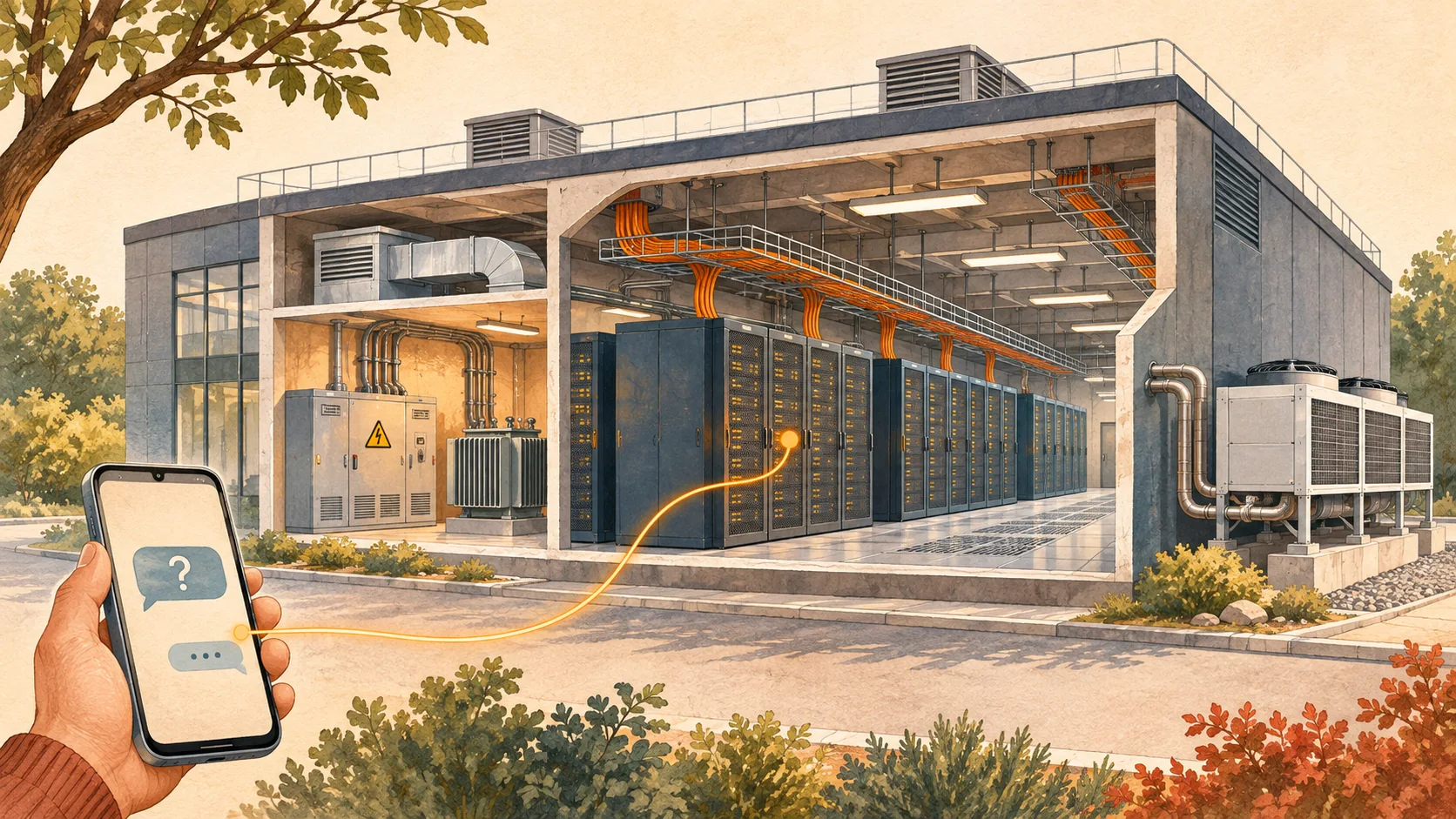
These machines have an address. They occupy buildings, depend on a power supply and give off heat that must be removed. To understand how a data centre dedicated to AI works, let us follow this request all the way to the servers.
The cloud starts in a building
A data centre is a place designed to run computer equipment. Servers run the applications there. Other equipment stores the files, connects the machines to each other and links them to the rest of the network.
On top of these computers come the facilities that let them be used day and night. Electricity must arrive reliably. Batteries and, depending on the site, generators take over during a power cut. Cooling keeps the equipment within its operating conditions. Physical access to the rooms is controlled.
Your e-mail, a WordPress website and an AI assistant may all depend on data centres. Yet they do not ask them for the same resources. A service that generates text with a large language model may need specialised accelerators and very fast exchanges between machines. This explains some of the differences between a classic computer centre and a facility built for AI workloads. IBM describes these components and their roles.
The word “cloud” describes the way these resources are accessed remotely. The hardware itself is still somewhere.
Your question arrives with a little context
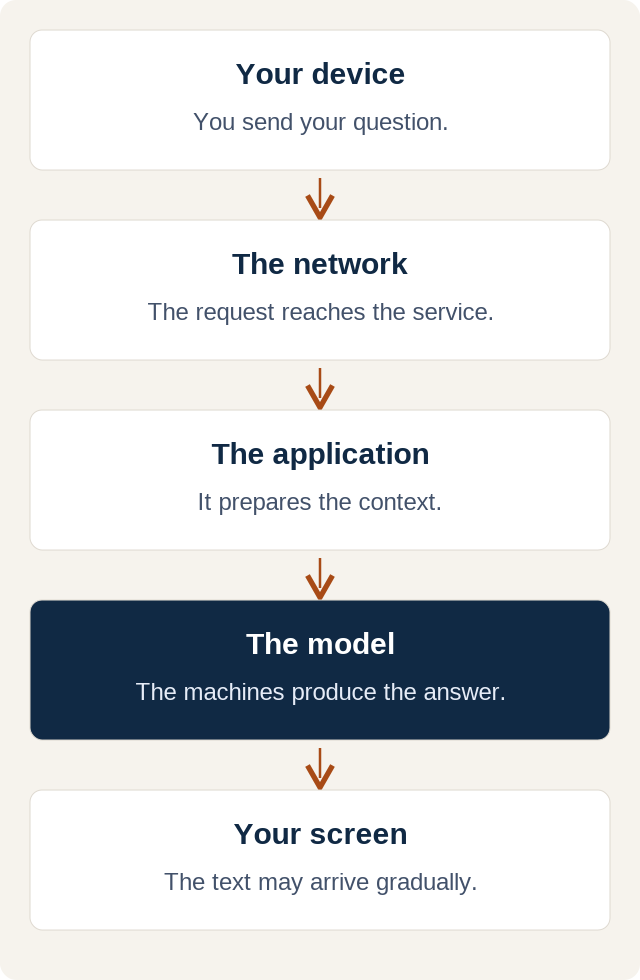
When you send your message, it travels over your internet connection and then through several network devices. The service receives it in its infrastructure. The exact route depends on your location, on how the service is organised and on the load at that moment. So your request does not necessarily reach the nearest building.
Before calling on the model, the application may check your access, apply its usage limits and prepare the necessary information. Your new question may be accompanied by part of the conversation, by instructions set by the service or by documents you added. The details vary from one product to another.
This distinction becomes useful when you build your own assistant. The website the visitor opens and the model that answers may run with two different providers. The first receives the request, calls the second through an API, then displays its result. An API is simply the interface that lets these programs exchange.
For the model, text becomes numbers
A language model does not work directly with letters as you see them. A tool called a tokenizer splits the text into units, tokens, then associates them with numeric identifiers. A token may correspond to a word, part of a word or a punctuation mark. The splitting depends on the model and on the language.
So there is no fixed conversion between a page of English, a page of Arabic and a number of tokens. This is also why a provider may bill by the amount of text processed and generated, rather than by the number of questions asked. The details of the splitting are explained in Hugging Face’s tokenizer documentation.
The model then uses these identifiers to retrieve numeric representations. Its computation layers transform them, taking the context into account. In a text-generating model, this work is used in particular to determine which tokens could come next, then to select one according to the generation settings.
This does not mean opening a file where your answer was already waiting. The system may nevertheless look up information in documents or on the web before writing. Search and generation can thus work together. Combining them does not remove the need to check a claim or a source.
The model learned before you arrived
For a model to produce these answers, it must first be trained. During this stage, its parameters are adjusted from data and learning objectives. These parameters are the numeric values that determine much of its behaviour.
Training the largest models takes sets of machines over a long period. But this full operation does not start again with every question. When you use the model that has already been prepared, you are in the phase called inference. The service loads or keeps the model in memory and uses it to process requests.
Your conversation can influence the answer because it is part of the context passed along. This does not mean the model immediately rewrites its parameters to learn your discussion permanently. Whether conversations are kept and possibly used for future training are separate questions again, linked to how the service works and to its terms. The journey described by Intel helps tell training and deployment apart.
A relatively small model can run on a personal computer. At the other extreme, some systems are spread over several accelerators. You need to know the model and the task before talking about the hardware required.
Why the answer appears gradually
Text generation often involves two distinct moments. The first processes the text supplied as input. This is called prefill. The second produces the rest of the answer, usually token after token. This is called decoding.
Part of the intermediate results can be kept in a working memory called the KV cache. The model uses it to avoid recomputing certain information about tokens already processed. This cache speeds up generation but takes up memory. It should not be confused with a history saved in your account or with memories kept between two conversations. Hugging Face explains this caching mechanism.
The application can pass on pieces of the answer as they become available. This is streaming. The display sometimes gives the impression that the AI writes letter by letter, whereas the fragments received do not necessarily correspond to letters or whole words.
The silence before the first sentence does not, on its own, tell you what the service is doing. It may include waiting for an available machine, processing the context, reasoning steps, calling a tool or simply network delay. This explanation of prefill and decoding by TNG shows why the time to the first token and the speed of what follows are two different measures.
Fast processors need data on time
In an AI server, the CPU keeps running the system and coordinating many operations. GPUs and other accelerators handle the calculations their architecture is suited to. A GPU can carry out many similar operations in parallel, which suits in particular the matrix calculations of neural networks.
Computing power is not enough, however. The values used by the model must arrive fast enough from memory. In some generation phases, the compute units could do more work but are waiting for the data they need. Increasing their power alone does not solve this problem.
HBM memory, used on some accelerators, allows very fast exchanges close to the chip. SSDs are used in particular to store files and models before they are loaded. They do not replace the fast memory used during computation. Free space on a disk therefore does not mean a server can run any model.
When the work is spread over several accelerators, the network between them also matters. They must exchange data and coordinate their operations. Slow communication can hold everything up. For example, NVIDIA’s GB200 NVL72 brings together 72 GPUs and 36 CPUs in a liquid-cooled architecture, with specialised interconnects. This system illustrates a high-capacity installation, not a configuration every AI application needs.
Electricity ends up mostly as heat
Electrical equipment gives off heat while it runs. The more powerful hardware you concentrate in a rack, the more heat must be removed from a small space. A server room must be designed for this constraint from the start.
Depending on the density of the equipment, cooling uses air, liquid circuits or a combination of both. With direct-to-chip cooling, a liquid flows through plates that pick up the heat in contact with the components. It is then carried to the rest of the building’s cooling system.
Water consumption depends on how this system finally rejects the heat, but also on the climate and on how it is operated. Having a liquid circuit near the chips does not, on its own, tell you how much water the site consumes. NVIDIA’s data centre design recommendations show the importance of handling power and cooling together.
The constraints do not stop at the building’s walls. A project must obtain enough electrical power and the equipment needed to connect to the grid. Buying the servers is not enough to be able to switch them on.
A short answer and a video do not cost the same
The International Energy Agency estimates that data centres used about 485 terawatt-hours of electricity worldwide in 2025. Its updated scenario expects about 950 TWh in 2030. This covers all data centres, not just conversations with AI, and the 2030 figure remains a projection.
The IEA’s 2026 report also highlights an important difference between uses. A short text generation, a video and a task carried out by an agent do not require the same amount of computation. A universal “per question” cost would hide these gaps, as well as the differences between models, machines and answer lengths.
Software also changes the bill. Several requests can be processed together to make better use of the equipment. Some calculations are reused. Other optimisations reduce the memory needed, sometimes at the cost of trade-offs in precision or quality. This explains how a service can become cheaper without waiting for all its machines to be replaced.
What this changes for your own project
If you want an assistant on your website, you usually do not need to start by buying GPUs. Your application can use a model provided through an API. Your hosting then runs the website and its logic, while the model provider handles generation. You still need to plan for the cost of this API and review the data you send to it.
If you want to run the model yourself, the choice becomes different. You need to check its licence, its size, its memory needs, the expected speed and the number of simultaneous users. A VPS suited to a web application is not automatically sized for a large language model.
This distinction also helps place our tools. Creating a website with Sahara AI, deploying an application from GitHub and hosting automations with n8n meet different needs. None of these uses means that a GPU cluster is included in your hosting.
So you can start from the service you want to provide. A catalogue, a support assistant or an automation do not necessarily call for the same architecture. The right choice will depend on the work to be done, your data and the level of control you need.